
Key Takeaway
During El Niño, roofs that have never leaked before can start leaking because intensified storms, including atmospheric rivers delivering 30 to 50 percent of annual precipitation in just a few events, push wind-driven rain past marginal flashing, worn pipe boots, and deteriorated seals that ordinary rain never stressed enough to expose. El Niño raises above-normal precipitation odds above 50 percent across much of coastal California from December through April. The defect was almost certainly already there. The storm just found it.
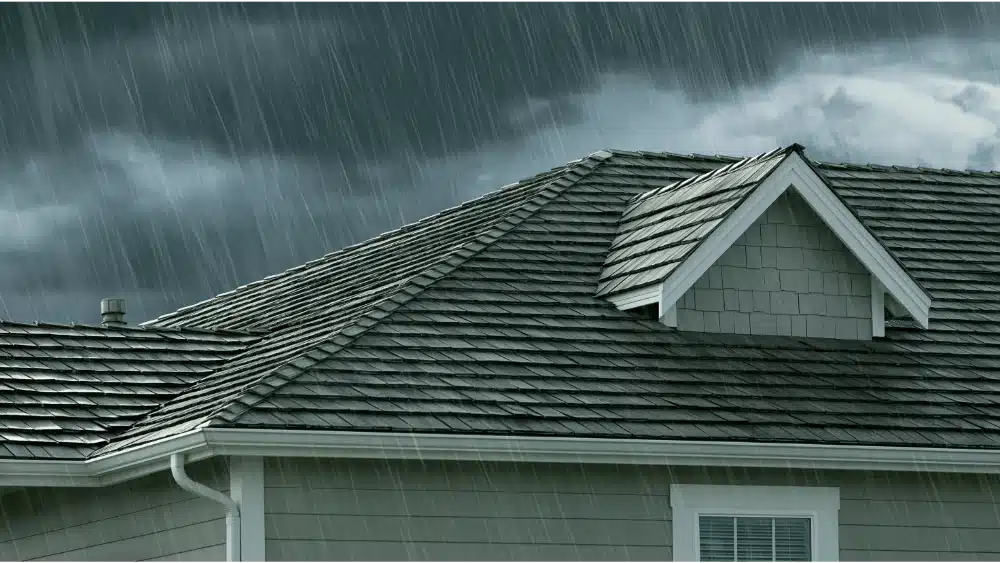
El Niño does not put a hole in your roof. What it can do is raise the odds of long, heavy, wind driven storms that push an existing weak point past anything it has faced before. That weak point might be damaged flashing, a shingle with worn seals, a cracked plumbing vent boot, or a gutter that cannot move water fast enough. It has probably been on the roof a while. The storm just found it.
If you are looking at a fresh ceiling stain or peeling paint on a wall in a home that has stayed dry for a decade, that is unsettling. Here is what we will cover: what actually changes during an El Niño winter, where water most often gets past the roof surface, what to do while it is still dripping, and how to tell whether you are looking at a targeted roof repair or something larger.
What an El Niño winter actually changes, and what it doesn’t
El Niño is a pattern in the tropical Pacific where warmer ocean surface temperatures shift atmospheric circulation, strengthening and extending the Pacific jet stream toward the West Coast, which in turn shifts storm-track probabilities. It is not a storm. No individual storm can be blamed on it. NOAA notes its influence over the United States is generally strongest from January through March, which is also when many roofs face their longest stretches of heavy rain.
As of the Climate Prediction Center’s September 10, 2026 diagnostic discussion, an El Niño Advisory is active, with a greater than 90% chance of a very strong event through fall and winter 2026 to 2027 and a 75% chance the October through December RONI value reaches +2.5°C. NOAA’s seasonal outlook puts above-normal precipitation odds above 50% across much of coastal California for portions of December through April. These figures change monthly and should be re-checked against the current CPC update.
How much rain San Diego and Sacramento see in an El Niño winter
Odds are not guarantees. The El Niño to wet-winter link is historically stronger in Southern California, where the precipitation signal from San Diego County north along the coast has been more consistent, than it is here in Northern California. San Diego homeowners have watched that pattern hold more often than we have, though even a strong event does not promise a wet season in any one city. The rain San Diego or Sacramento receives during El Niño storms often arrives in a handful of atmospheric river events rather than steadily across the rainy season. Those atmospheric rivers supply roughly 30% to 50% of annual precipitation regardless of the seasonal label. What matters for your roof is not the name of the season. It is the kind of storm that shows up.
Why a roof that has never leaked can start leaking now
FEMA treats a roof as a layered water-control system. The roof covering, underlayment, flashing, roof penetrations, chimneys, vents, and skylights all have to work together. When one transition is loose, deteriorated, or was never integrated correctly, that detail can shed a light shower for years without a single drop reaching your ceiling.
Think of it as a performance threshold. A component can be intact enough for a ten-minute shower, marginal under six hours of sustained rain, and genuinely vulnerable only when the wind comes from one particular direction. A first visible leak rarely means the defect appeared that day. More often it means the storm finally combined enough water, wind, and time to expose it. That is usually a roof repair waiting to be identified, not a roof that has failed.
Four storm stresses that expose hidden roof problems
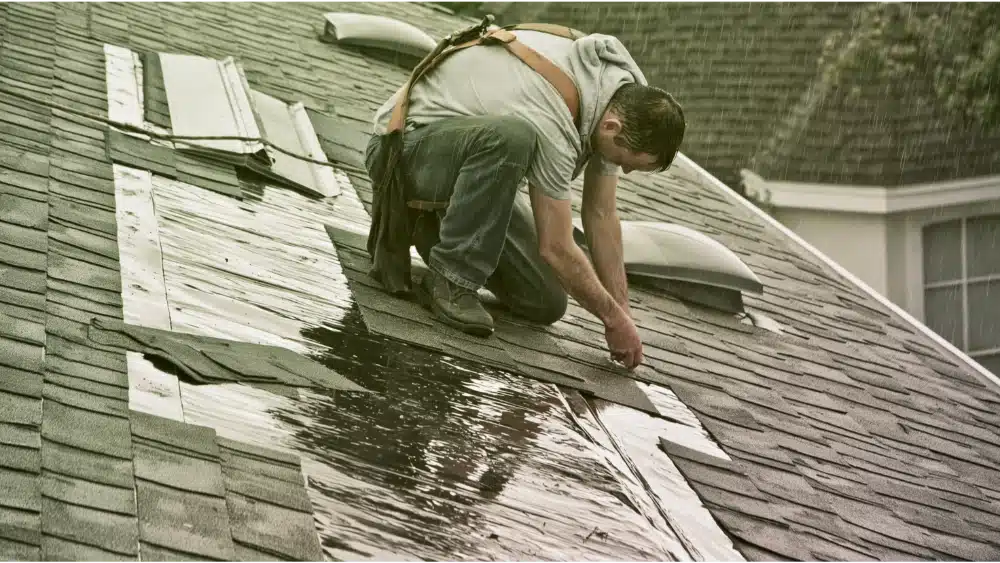
Severe weather tests a roof in four distinct ways. Understanding which one applies to your situation tells you a lot about where to look, and it is the same framework we use when we walk a roof after a storm. Ice dams, the classic cold-climate culprit, are rarely the issue here. Wind and water volume are.
Angle: wind driven rain pushes water where gravity never would
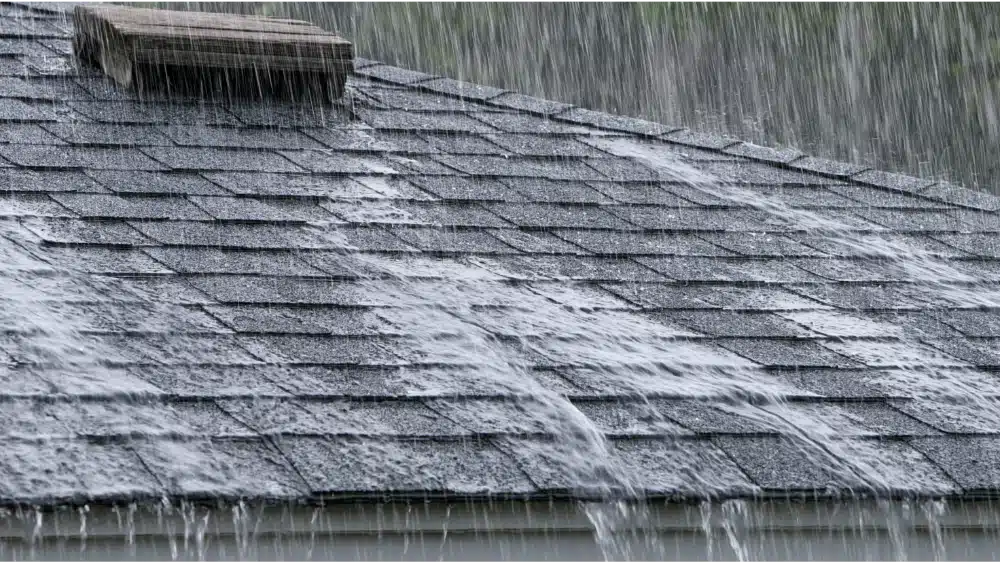
Vertical rain runs off. Wind driven rain gets forced sideways and even uphill, underneath shingle laps, into seams, around roof penetrations, past rake and eave edges, and behind roof-to-wall transitions. You do not need missing shingles for this to happen. IBHS testing found that a sealed roof deck reduced water entry by as much as 95% compared with an unsealed deck after roof-cover damage, which shows how much the layers beneath the roof surface matter once wind driven rain gets under the covering.
Volume: a major storm, clogged gutters, and drainage systems that cannot keep up
Valleys, gutters, downspouts, scuppers, and drains have to move all of it simultaneously during a heavy downpour. A single major storm in California can deliver roughly 10% to 30% of a location’s annual precipitation, according to a NOAA-indexed study of 176 stations. Clogged gutters and blocked valleys back water up under the roof edge, where it can wick into fascia, sheathing, and the first course of shingles. What looks like a roof failure is sometimes a failure of the drainage systems, and clogged gutters are one of the few roof problems a homeowner can often spot from the ground.
Duration: hours of prolonged rain instead of minutes
The same study found that roughly 60 to 120 hours of rain per year account for more than half of Northern California’s annual rainfall. The heavy lifting happens in a handful of long events. Water wicks through tight joints given enough time, and absorbent roofing materials saturate rather than shed. A seam that handles a brief shower may not handle ten straight hours of prolonged rain.
Sequence: repeated storms through the season
Northern California averages roughly 25 to 45 rainfall events per year, with about 40% to 50% tied to atmospheric rivers. When repeated storms arrive before sheathing, insulation, and wall cavities have dried, moisture intrusion compounds instead of clearing. This is why musty odors or water stains sometimes show up weeks into storm season rather than during the first storm, and why repeated rain can turn one small entry point into recurring leaks.
Where is the water most likely getting in?
When the leak appears tells you a great deal about where to look. The table below connects common patterns to the roof areas worth inspecting first.
| What you’re seeing | Likely areas to inspect |
|---|---|
| Leaks only during windy rain | Rakes, ridge, roof-to-wall flashing, vents, lifted shingles or tiles |
| Leaks only after hours of heavy rain | Flashing laps, valleys, underlayment, low slope sections |
| Stain near an exterior wall | Clogged gutters, eaves, fascia, step flashing, siding-to-roof transition |
| Stain near a chimney or skylight | Counterflashing, step flashing, curb flashing |
| Leak after high winds or falling debris | Broken tiles, missing shingles, punctures, damaged vents |
| Leak under rooftop equipment | Solar, HVAC, pipe and conduit roof penetrations |
FEMA identifies flashing at penetrations, walls, perimeters, valleys, chimneys, vents, and skylights as the critical water-control details, which is why our roof inspections cover roofing materials, gutters and downspouts, flashing and sealants, ventilation, structural condition, chimneys, vents, and skylights together rather than one at a time. A table narrows the search. It does not replace a professional roof inspection.
How leaks differ on asphalt, tile, metal, and low slope roofs
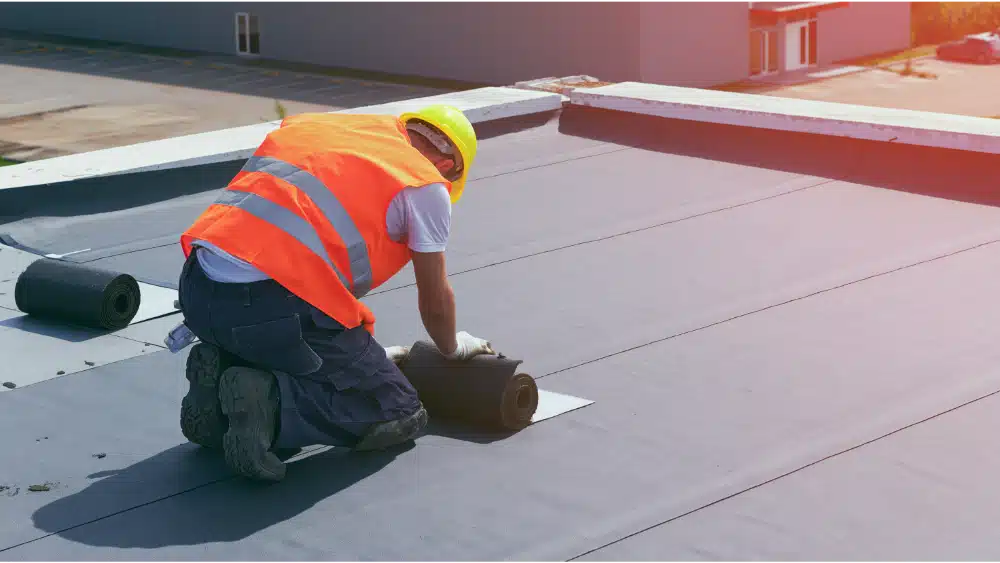
The four stresses stay the same across roof types. The entry points shift with the roofing materials.
- Asphalt shingle: lifted tabs, seal strips weakened by years of sun exposure, missing shingles after high wind, worn pipe boots, and flashing at walls and chimneys.
- Tile: cracked or displaced concrete tiles matter, but the real water barrier is the underlayment beneath them. A tile roof can leak with every tile in place.
- Metal: seams, exposed fasteners and their washers where present, and roof penetrations. Thin metal panels can also be dented or lifted by wind-carried debris.
- Flat and low slope: ponding water, blocked drains and scuppers, seam separation, and the curbs around rooftop equipment.
We work across asphalt shingle, tile, metal, and flat systems including single-ply and silicone, which matters here because diagnosing a tile roof correctly requires knowing that the tile is a shield, not the seal.
Why the ceiling stain isn’t directly below the roof leak
Water rarely falls straight down once it gets past the covering. It runs along the underside of the roof deck, down a rafter, across framing, through insulation, and emerges at whatever seam, fixture, or low point it reaches first. The entry point on the roof can sit several feet away, sometimes farther on a low-slope ceiling.
This is the most common reason homeowners misjudge a leak source, and the reason spot-caulking the obvious spot so often fails.
Checking your attic space for water stains and musty odors
If your attic space is safe and dry to enter, a flashlight pass can reveal problems long before the ceiling shows anything at all. Look for dark or shiny sheathing, rusted nail shanks, compressed or wet insulation, water stains tracking down rafters, and daylight at penetrations. Trust your nose too. Musty odors in an attic space usually mean moisture has been present more than once, and that is worth mentioning when you call for a roof inspection.
What to do while the roof is actively leaking
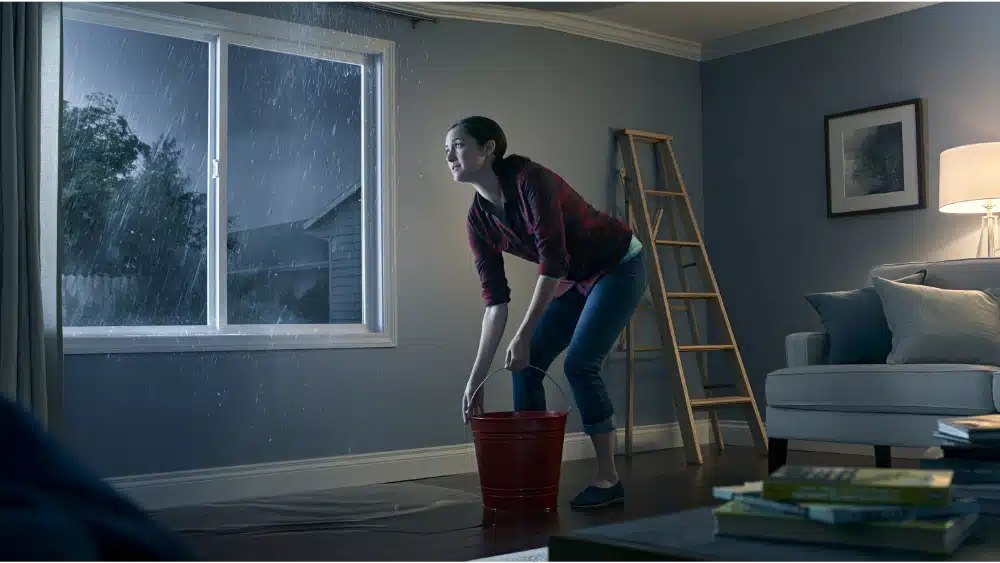
Do this now
- Move furniture, electronics, and anything else out of the drip path.
- Contain the water with a bucket or bin and protect the floor beneath it.
- Photograph the active leak, the water stains, and any interior damage.
- Shut off power to affected fixtures if you can do so safely.
- Call a qualified roofing contractor if temporary weather protection is needed.
Avoid doing this
- Do not climb onto a wet or wind-exposed roof during a storm. This is where people get hurt.
- Do not rely on blind caulking as a permanent roof repair.
- Do not puncture or pull down a sagging ceiling without considering electrical and collapse risk.
- If a storm-damage claim may be involved, the California Department of Insurance advises taking reasonable temporary measures but holding off on extensive permanent repairs until the insurance company has had an opportunity to assess the loss.
What to do after the heavy rain stops
- Schedule a professional roof inspection.
- Write down the date, how long the storm lasted, the wind direction, which room was affected, and how the leak behaved. That is genuinely useful diagnostic information.
- Dry wet or damp materials within 24 to 48 hours where it is safe to do so. EPA guidance also stresses correcting the water source, since drying the ceiling without stopping the entry only resets the clock.
- Check gutters and downspouts for blockage from the ground.
- Contact your insurance company if storm damage may be involved, and read the actual policy rather than assuming coverage.
- Keep receipts for any reasonable temporary mitigation.
Does one new leak mean you need a full roof replacement?
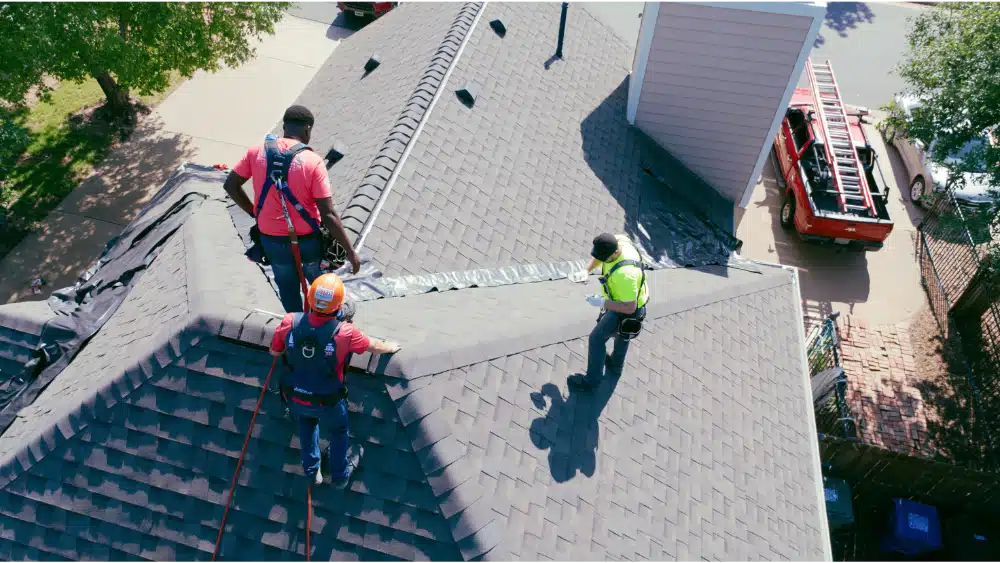
Usually, no. The honest answer depends on condition and extent, and that is what a roof inspection is for.
- Inspect when the source and extent of the roof problems are unknown. Almost every case starts here.
- Repair when the issue is an isolated flashing, penetration, covering, or drainage defect. Most single leaks land on the roof repair side.
- Replace when there is widespread deterioration, multiple leaks in separate locations, a compromised roof deck, or a point where repairs no longer represent a sound long-term answer.
Age alone is a poor rule. We have inspected twenty-year-old roofs that needed one flashing detail corrected and much newer roofs with systemic problems. Most roof replacements we recommend follow a pattern of failure, not a single stain. The goal is to stop the root cause, not cover the symptom. Done once, done right. If replacement is the right call and the timing is difficult, financing options exist so the decision can be made on the condition of the roof rather than on the calendar.
Getting your roof ready before storm season arrives
A little attention now is often what separates a scheduled roof repair from costly emergency repairs in the middle of January. None of it prevents leaks with certainty, but it removes the most common causes before the next storm.
- Clear debris, leaves, and needles from gutters, downspouts, and valleys.
- Check flashing and seals at walls, chimneys, vents, and other roof penetrations.
- Inspect shingles and tiles from the ground for missing pieces, lifted tabs, or cracks.
- Look for prior attic space or ceiling water stains you may have dismissed.
- Review solar and rooftop HVAC attachment points.
- Trim overhanging branches where appropriate.
- Photograph your current roof and exterior condition for your records.
- Schedule a professional inspection before the first heavy rain arrives.
Vetting a roofing contractor, from CSLB license to GAF Master Elite contractor status
Manufacturer credentials are worth asking about. A GAF Master Elite contractor designation, for example, indicates a roofer has met that manufacturer’s requirements for installing its systems, and other manufacturers run similar programs. We install Owens Corning roofing systems among other materials, and we will walk you through exactly what a given system’s documentation covers.
Start with the license, though. California generally requires a licensed contractor when a project needs a permit, uses workers, or reaches $1,000 or more in combined labor and materials, and home improvement down payments are generally capped at 10% of the contract price or $1,000, whichever is less. Verify any license at the CSLB.
Frequently Asked Questions
Why does my roof leak sometimes and not others?
Because the leak depends on conditions, not just rain. Wind direction, rainfall rate, storm duration, and back-to-back saturation all have to line up before a marginal roof detail lets water through. That is the performance threshold at work.
Does homeowners insurance cover roof leaks from rain?
It depends on the cause and your policy language. The California Department of Insurance notes that rain entering through an opening created by a covered peril is treated differently than long-term wear, deferred maintenance, or gradual leakage. Report the damage, take reasonable temporary measures, keep receipts, and read the policy itself.
Should I get a professional roof inspection before an El Niño winter?
If it has been a few years, yes. An inspection ahead of storm season is the least expensive way to find small roof problems while they are still small, and it gives you documented photos of your roof’s condition before any storm arrives.
Why is my roof leaking even though it isn’t raining?
Water trapped in insulation or sheathing can keep draining for days after a storm. Condensation from poor attic ventilation, or runoff from an adjacent surface, can also mimic a roof leak. Persistent musty odors usually point to retained moisture somewhere in the assembly.
What is the most common location to find a roof leak?
Flashing and roof penetrations, rather than the open field of the roof. Roof-to-wall and chimney flashing, valleys, plumbing vent boots, skylight curbs, and rooftop equipment mounts are the usual suspects. FEMA identifies exactly these transitions as the critical water-control details.
Talk to a roofing team that will tell you what it actually found
Your real question is probably simple: is this a roof repair or a replacement? An inspection answers it with clear findings and photos of what we saw, not pressure. We are family-owned and operated, we use in-house crews rather than subcontractors, and we hold CSLB License #1031864. Our offices in Sacramento and Roseville serve Northern California, along with Fresno, Redding, and Boise.
Request a free, no-obligation quote or schedule a roof inspection. It is a quick conversation about your home, not an application. Call 916-745-6699 or email info@cobexcg.com. If storm damage may be involved, we can work with your homeowner’s insurance through the claim process.