
Key Takeaway
One roofing square equals exactly 100 square feet of roof surface, and most homes require between 20 and 30 roofing squares. To find your count, divide total sloped roof surface area by 100. Roof pitch, waste allowance, and roof complexity all affect how many squares are ordered, so the number on your estimate may differ from the net measurement.
One roofing square equals 100 square feet of roof surface. To calculate how many roofing squares your roof has, take the total square footage of the roof surface and divide it by 100. A roofing square is simply a unit of measurement used across the roofing industry, roughly the area of a 10 foot by 10 foot section of roof.
If you’re holding a roofing estimate that says “24 SQ” and wondering whether that number reflects your actual house, you’re asking a fair question. Understanding roofing squares is the quickest way to read a proposal with confidence. Below, we’ll walk through how roofing squares are calculated, how roof pitch and waste change the roofing squares required, and what the square count doesn’t tell you about the roofing project itself.
What Is a Roofing Square? (And What 100 Square Feet Really Covers)
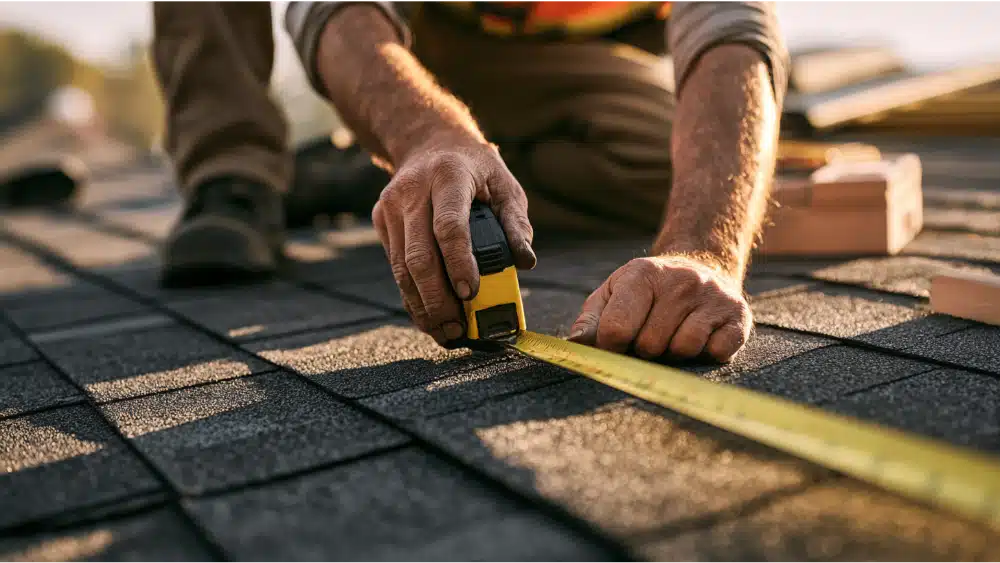
A square in roofing means 100 square feet of roof surface, period. The 10 by 10 visualization helps, but a roofing square doesn’t have to be a literal square shape. It’s 100 square feet of roof area in any arrangement. The National Roofing Contractors Association adds a useful nuance: a square also describes the quantity of materials needed to cover 100 square feet of roof deck, which matters for products like shingles that install with overlaps. The unit appears in NIST measurement tables and has been the industry standard for generations of roofers.
The math runs both directions: squares = square footage ÷ 100, and square footage = squares × 100. Most homes land somewhere around 20 to 30 roofing squares.
| Roofing squares | Roof square footage |
|---|---|
| 1 | 100 sq. ft. |
| 5 | 500 sq. ft. |
| 10 | 1,000 sq. ft. |
| 20 | 2,000 sq. ft. |
| 25 | 2,500 sq. ft. |
| 30 | 3,000 sq. ft. |
Why Roofers Measure in Squares, and What Roofing Square Cost Really Means
Roofing squares give everyone one shared unit. The manufacturer packages shingles by the square, the supplier prices materials by the square, and the crew plans labor by the square. The count also helps determine how much material shows up on delivery day. That’s why you’ll sometimes see a roofing square cost quoted: it blends materials and labor costs into a single per-square figure.
Those numbers swing widely by region, roofing material system, and roof complexity, which is why we don’t publish ranges. We take precise measurements of the roof first, then give you a number that belongs to your property.
Roofing Square vs. Square Foot vs. Bundle: How Many Bundles Cover a Roofing Square?
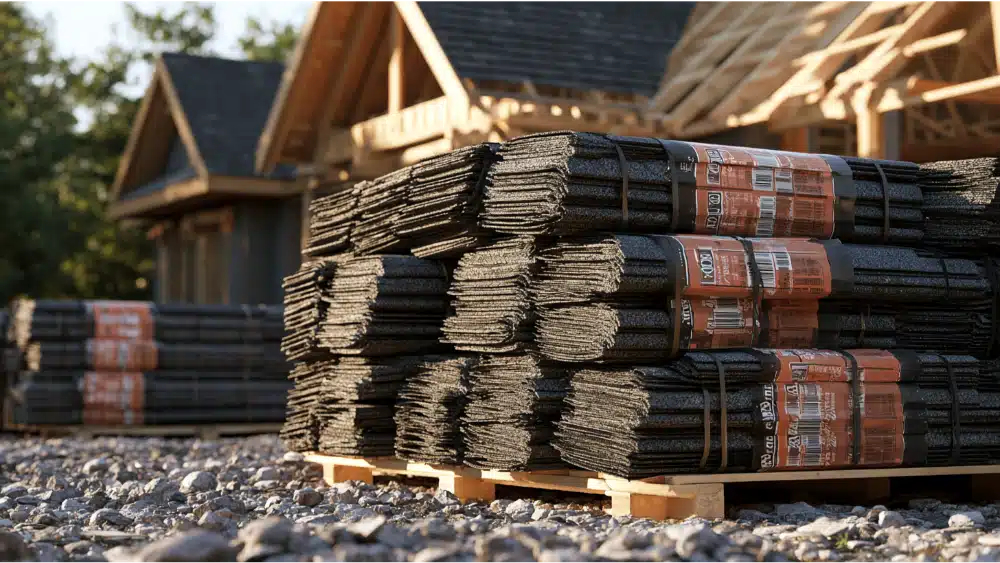
A roofing square is an area unit. A bundle is a manufacturer’s package of shingles. They aren’t interchangeable. Three bundles per square is common for 3-tab and many architectural asphalt shingles, but it isn’t a universal rule. Heavier and premium shingles can require four or five bundles to cover the same 100 square feet, and other roofing materials such as tile, metal panels, and the single-ply membrane used on a flat roof arrive in their own units entirely.
Here’s a detail most guides skip: one square of roofing material sold as “nominal” may publish slightly less than exactly 100 square feet of installed coverage, with current manufacturer data sheets listing examples around 98.4 to 99.9 square feet. The wrapper or current data sheet for the specific shingles controls the math, whether that’s an Owens Corning system or another line we install.
Calculating Roofing Squares: Two Methods That Actually Work
Method 1: Measure each roof plane, then divide by 100
Measure the length and width of each rectangular roof plane and multiply to calculate its area. Triangular and irregular sections need the appropriate area formula. Add every plane together for the total square footage, then divide by 100 to get the roofing squares needed. This is the cleanest way to calculate roof square footage when reliable plane dimensions are available.
Method 2: Start with the home’s footprint and apply a roof pitch multiplier
Roof pitch is the ratio of vertical rise to horizontal run, written as 4:12 or 6:12. Multiply the horizontal footprint by the pitch multiplier, which comes from √[1 + (rise ÷ 12)²].
| Roof pitch | Multiplier | Increase over footprint |
|---|---|---|
| 3:12 | 1.031 | 3.1% |
| 4:12 | 1.054 | 5.4% |
| 5:12 | 1.083 | 8.3% |
| 6:12 | 1.118 | 11.8% |
| 8:12 | 1.202 | 20.2% |
| 10:12 | 1.302 | 30.2% |
| 12:12 | 1.414 | 41.4% |
A 12:12 roof carries about 41% more roof square footage than the flat area beneath it, so the number of roofing squares climbs steadily with pitch. Steep pitches also mean more materials and more labor, since crews need additional staging and fall protection to work safely. Two homes with identical footprints and different roof pitch will never need the same quantity of shingles.
The mistake that doubles your roof size
If your length times width is the full horizontal footprint of the building, the slope factor already accounts for both sides of a gable. Don’t multiply by two again. Several online roofing calculators make exactly this error and return roughly double the real number of roofing squares. Full footprint, one individual roof plane, and half-span are three different measurements. Sections at different pitches have to be measured separately, then added, which is why complex roofs resist shortcut math.
Worked Example: How to Calculate Roofing Squares on a 40 x 30 Roof
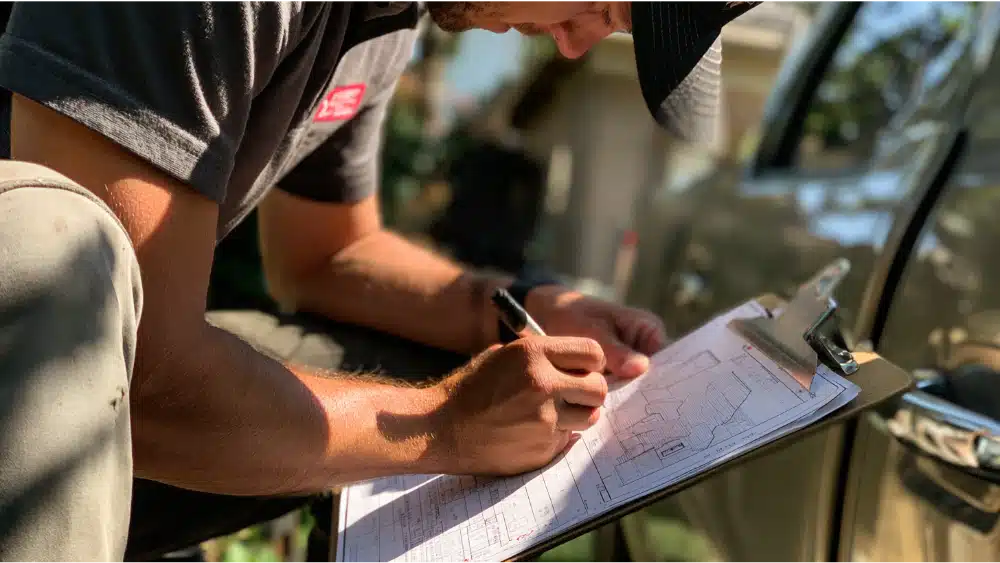
An illustrative example, using a simple gable roof over a 40 by 30 foot footprint at a uniform 6:12 pitch:
- 40 × 30 = 1,200 sq. ft. horizontal footprint
- 1,200 × 1.118 (6:12 multiplier) = about 1,342 sq. ft. of actual roof surface area
- 1,342 ÷ 100 = 13.42 net roofing squares
- Waste allowance is applied after the net area is calculated, never before
- The final figure converts into the selected roofing material’s package unit
Two key points: keep the decimals through the measurement, and save the rounding for when you’re ordering materials rather than the middle of the math.
Why Your Roof Square Footage Isn’t Your Home’s Square Footage
Listed home square footage describes interior living space. Roof square footage describes sloped exterior surface area, and the two rarely match. What moves the number: how many stories the home has, the size of the footprint, roof pitch, overhangs, attached garages and porches, dormers, and multiple roof sections at different pitches.
Here’s the counterintuitive part. A two-story home can have less roof area than a single-story home with identical living space, because its footprint is smaller. Never use your home’s listed square footage as a stand-in for the roof.
Net Squares, Waste Factor, and the Roofing Squares Actually Ordered
| Term | What it means |
|---|---|
| Net roofing squares | Measured sloped surface area ÷ 100 |
| Waste allowance | Extra materials for cuts at valleys, hips, ridges and penetrations, plus roof complexity and shingle layout |
| Order quantity | What actually gets delivered to the roofing project |
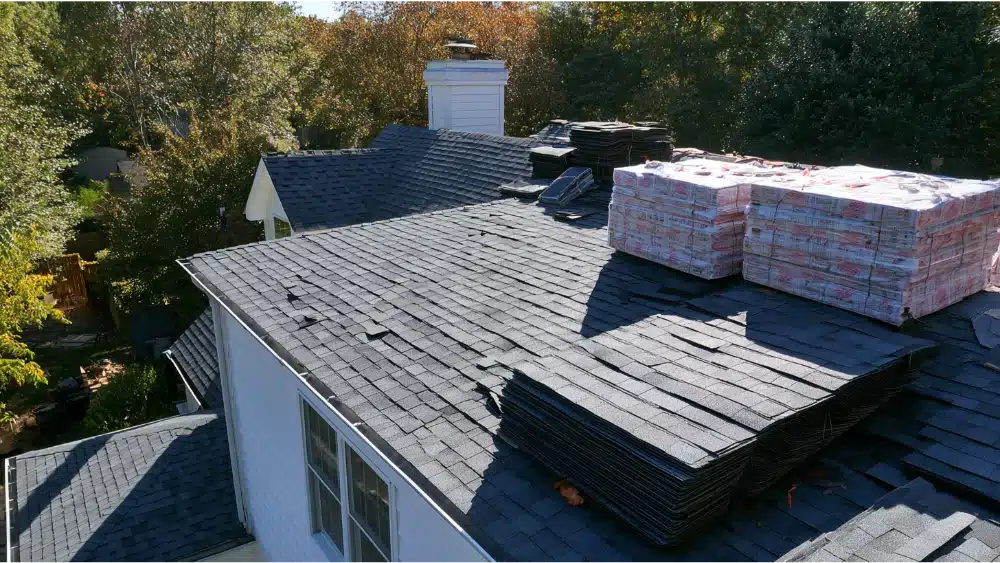
Manufacturer guidance for homeowners commonly suggests allowing up to about 10% overage. An NRCA technical paper cites roof replacement allowances commonly falling in the 10% to 20% range depending on roof configuration, with complex roofs sitting at the higher end. There is no single universal waste percentage, and anyone who tells you otherwise is guessing. The point is simply having enough material on site to finish the job cleanly.
So ask one question: is this square count the measurement, or the materials ordered after waste? A clear proposal answers that without being asked.
What the Roofing Square Count Doesn’t Tell You About Roofing Costs
A roofing square measures field area only. It says nothing about underlayment and leak barrier, starter strip, ridge and hip cap, drip edge, valley treatment, step and pipe flashing, ventilation, decking condition, how many tear-off layers are coming off, disposal, or how hard the roof is to access.
We install complete roofing systems, so the scope is what you’re actually buying. Two estimates can show the same number of roofing squares and describe two very different roofs. The right materials installed correctly protect the home longer, and that’s where the value sits.
How to Compare Estimates from Roofing Contractors When the Square Counts Don’t Match

- Is this the net measurement, or the order quantity after waste?
- What waste factor was used, and why does this roof need it?
- Which product’s specification controls bundles per roofing square?
- Are starter strip and ridge cap counted separately from the field?
- Does the scope include tear-off, a decking allowance, flashing, ventilation, and cleanup?
Two honest proposals can legitimately differ. What matters is whether the contractors will explain the difference in writing with a detailed breakdown. Our in-house crews work from measurements our own roofing professionals take, and we walk homeowners through the numbers before anything is signed.
How to Check Your Roof Square Footage Without Getting on the Roof
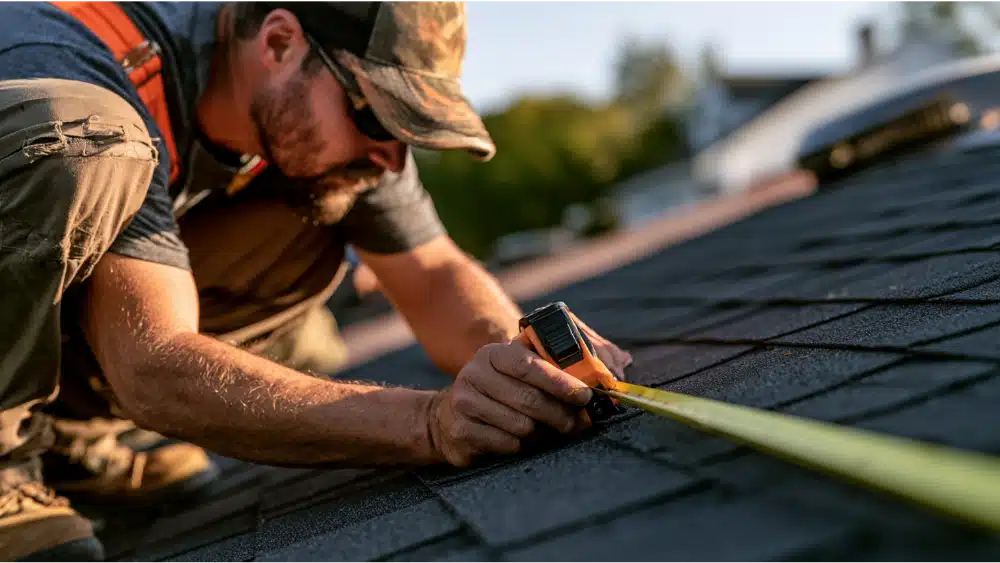
Please don’t walk your roof to verify a number. Fall prevention is a serious matter even for trained roofers, and manufacturer measurement guides tell homeowners without safe access to call a professional instead. Safer options: review an existing roof or measurement report, use reliable building plans, take ground-level measurements with a measuring tape where footing is safe, check pitch from an accessible attic, or have licensed roofing professionals inspect and measure for you.
California Homeowners: Where the Square Count Belongs in Your Written Contract

The California Contractors State License Board requires a written contract for home improvement work over $500. That contract should describe the materials and amounts, the work, the payment schedule, permit responsibility, the completion date, and the contractor’s license number. Any change in scope belongs in a written change order. CSLB also caps the down payment at $1,000 or 10% of the contract price, whichever is less, excluding finance charges. Your roofing square count should live inside that written scope, not stand alone as the explanation.
Frequently Asked Questions
How much is 1 square in roofing?
One roofing square is 100 square feet of roof surface. A per-square figure typically covers both materials and labor, and it can vary depending on region, roofing material, and roof complexity, so a generic number isn’t much use. A free quote based on your actual roof is the honest answer.
What is a square on a roofing estimate?
It’s a unit of area. A line reading “24 SQ” means roughly 2,400 square feet of roof surface. Ask whether that figure is the net measurement or the materials ordered after waste.
How many squares is a 10×10 roof?
A 10 foot by 10 foot area is exactly one roofing square, or 100 square feet. If that’s the footprint rather than the actual surface area, apply the roof slope factor first, because the actual roof plane will be larger.
What is the best roofing square?
There’s no “best” square. The unit is fixed at 100 square feet and that is the industry standard. What varies is the roofing material system installed within each square, so compare shingles and their warranty documentation rather than shopping the unit itself
Get Precise Measurements and a Clear, Written Number
We measure your roof plane by plane, show you the net roofing squares alongside the waste allowance, and put the full scope in writing. No surprises. We’re family-owned and operated, we use in-house crews, and we serve homeowners in and around Roseville and the greater Sacramento area. Request a free, no-obligation quote or schedule an inspection at 916-745-6699. It’s a short conversation, not an application. CSLB License #1031864.