
Key Takeaway
Essential roof safety equipment includes secured ladder access, fall prevention guardrails rated to withstand 200 pounds of force, properly anchored fall arrest systems using a full-body harness, and task-specific PPE. OSHA requires fall protection at any unprotected edge 6 feet or higher. A harness alone is not a complete system; you also need a rated anchorage point, clearance calculations, and a rescue plan.
Roof safety equipment is a complete system, not a single product off a shelf. It includes secured access, fall prevention such as roof edge guardrails and covered openings, a properly anchored fall restraint or fall arrest system, task-specific PPE, and a plan for falling objects and rescue. A safety harness by itself is not a fall protection system. If you’re weighing whether to go up yourself or call someone, here is what should be in place before anyone sets foot on your roof.
Why Roof Safety Equipment Works as a System, Not a Shopping List
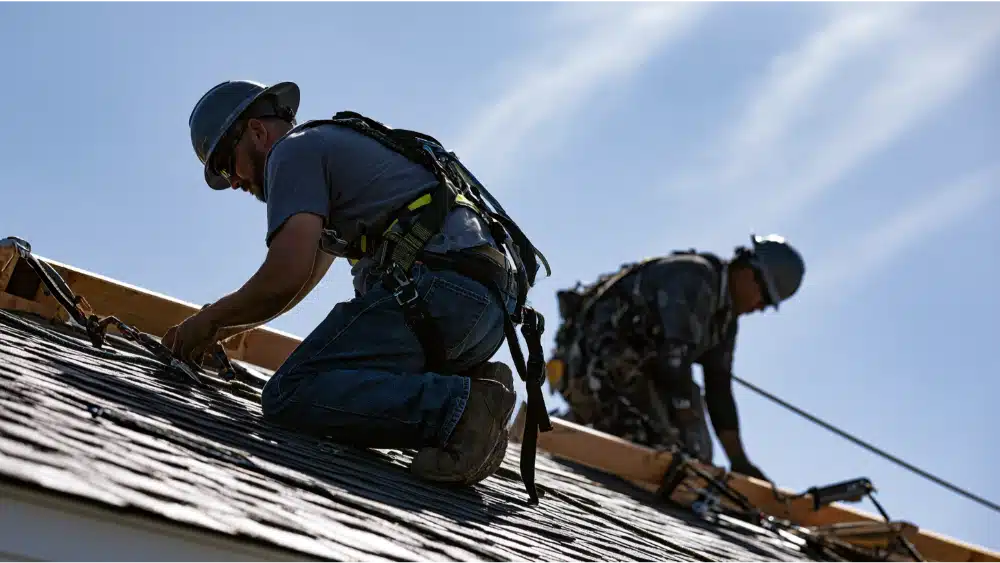
NIOSH reported that construction accounted for 95% of fatal occupational falls from elevation in 2024. The Bureau of Labor Statistics recorded 104 fatal work injuries among roofers as an occupation that same year, a rate of 48.7 per 100,000 full-time-equivalent workers, while the roofing contractor industry recorded 120 fatal injuries, 96 of them from falls, slips, or trips. Those are two different measures and shouldn’t be used interchangeably.
NIOSH’s hierarchy of controls explains why even great equipment doesn’t solve this on its own. Eliminate the hazard of working at height first. Then use engineering controls like barriers and guardrails, which keep workers secure without depending on anyone’s judgment in the moment. Personal equipment comes last, because it protects only when it is selected correctly, worn correctly, and anchored correctly.
Before Any Equipment: Does Anyone Need to Be on the Roof?
You can usually find the answer from the ground. Binoculars catch lifted shingles, displaced tile, and sagging lines. An attic check reveals daylight through the deck, damp insulation, or staining along rafters. A professional inspection answers the question properly, at a price far below what a fall costs.
Stay off the roof when the surface is wet, icy, or mossy, when the pitch is steep, when storm damage may have weakened the deck, when the home is more than one story, or when power lines run near your access path. In those conditions, handing the job to a trained crew is the only sound option.
What Safety Equipment Is Needed for Working on a Roof?
Safe Access Equipment
A properly rated extension ladder should extend at least 3 feet above the roof edge, sit at roughly a 4:1 angle, rest on stable level ground, and be secured to ensure it can’t shift mid-climb (OSHA 1926.1053). Keep ladders and tools at least 10 feet from power lines, maintain three points of contact, and face the ladder when climbing. Stabilizers and scaffolding are options where the job calls for them.
Fall Prevention: Roof Edge Guardrails, Covers, and Warning Lines
Guardrail top edges generally sit 42 inches above the walking surface, plus or minus 3 inches, and must withstand at least 200 pounds of force at the top edge (1926.502(b)). Skylights and roof openings are among the most underestimated hazards on any roof and need covers or guarding (1926.501(b)(4)). Warning lines on qualifying low-slope work are generally set at least 6 feet from the edge, but a warning line is a visual boundary, not a physical barrier. Safety nets are another recognized option.
Fall Restraint vs. Fall Arrest: Safety Harness, Anchors, and Lifelines
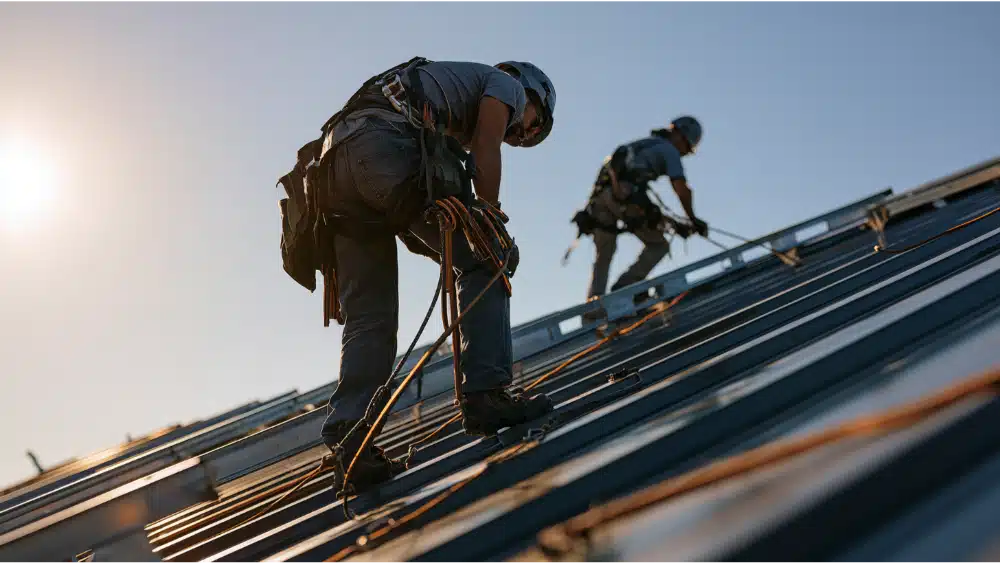
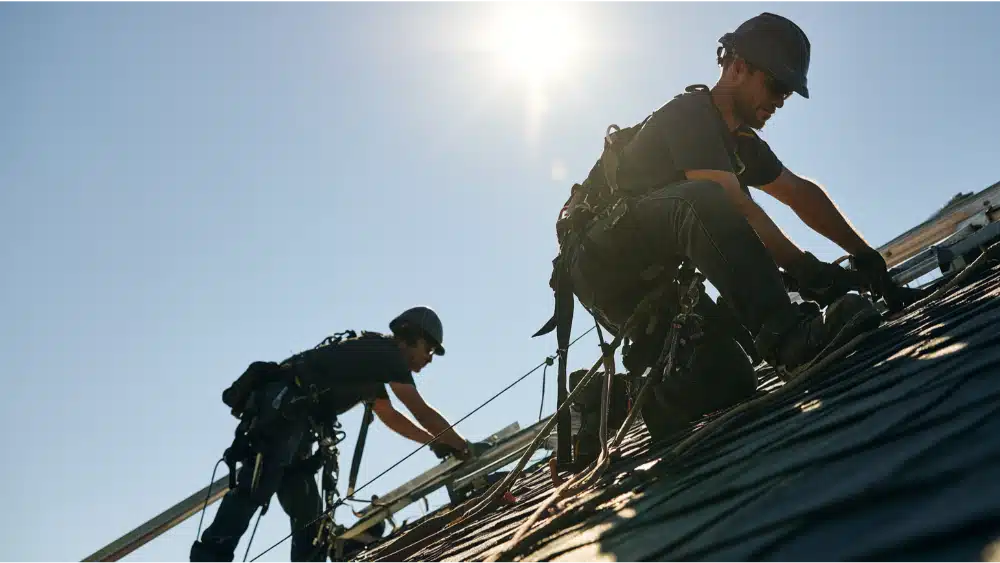
Fall restraint is rigged so a worker physically cannot reach the edge. Fall arrest allows access to the hazard and stops a fall already underway. Arrest follows the ABC framework: Anchorage, Body support (a full-body safety harness), and Connectors such as a lanyard, rope grab, or self-retracting lifeline. Body belts have not been acceptable for fall arrest since January 1, 1998. Arrest also requires clearance below and prompt rescue of a suspended worker, which is why restraint and guardrails are preferred wherever the work allows.
Retail kits bundle a harness, lifeline, rope grab, and anchor at a modest price, and the better kits are well-made products. What the price doesn’t buy is a hazard assessment, trained fitting, clearance math, or a rescue plan. Harnesses also age out, with service limits printed on the product label.
Anchors: Why “Something Sturdy” Is Not an Anchor Point
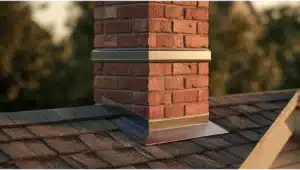
An anchorage must support at least 5,000 pounds per attached worker, or be engineered with a safety factor of at least two under a qualified person’s supervision (1926.502(d)(15)). Maximum arresting force with a body harness is 1,800 pounds, free fall is generally limited to 6 feet, and deceleration distance to 3.5 feet. Gutters, plumbing vents, chimneys, railings, and HVAC curbs are not tie-off points. Anchors fasten into structural roof members per manufacturer instructions, and placement must account for swing falls.
Task-Specific PPE and Protection for the Ground Below
PPE follows the task: hard hats where falling-object hazards exist, eye protection, gloves matched to the material, hearing protection around nailers, slip-resistant footwear, and high-visibility clothing near traffic. Below the work, that means tool control, toeboards, barricaded areas, and first aid on the jobsite. Roof brackets and good boots help a great deal with footing. They never replace a required fall protection system.
What Does OSHA Require for Fall Protection on a Roof?
Federal OSHA requires fall protection on construction sites wherever a worker is exposed to an unprotected edge 6 feet or more above a lower level (1926.501). A low-slope roof is 4:12 or less; steeper than that is a steep roof. On steep roofs, the acceptable options are guardrails with toeboards, safety nets, or a personal fall arrest system. Low-slope work permits certain warning-line and monitoring combinations. Training by a competent person is required (1926.503), state plans may be stricter, and quoting a section number doesn’t make an untrained setup safe.
How Often Should a Fall Protection System Be Inspected?

Personal fall arrest equipment must be inspected before each use, and defective components removed from service (1926.502(d)(21)). Crews check harnesses for webbing and stitching damage, then buckles and D-rings, connectors and snap hooks, lifelines, impact indicators, anchors, ladder rails and locks, and legible labels. Anything that has arrested a fall is retired permanently. That routine is what ensures the system works the one time it matters.
What to Ask a Roofing Contractor About Safety on Your Home
- How will the crew access the roof, and where will the ladder be set?
- What fall protection fits this roof’s slope and height?
- How are anchors, harnesses, and lifelines selected and inspected?
- How will skylights and roof openings be protected?
- Who oversees safety on site, and who calls me if weather pauses the work?
You’re not auditing compliance. You’re listening for whether the answers feel specific and already thought through. A bid priced well under the others usually means something was left out, and safety is an easy place to cut. We’ve never competed on price. Our crews are in-house rather than subcontracted, and a Client Success Manager keeps you updated. Done once, done right.
Frequently Asked Questions\
What are the OSHA requirements for safety on a roof?
Fall protection is required at unprotected edges 6 feet or more above a lower level. Steep roofs call for guardrails with toeboards, safety nets, or a personal fall arrest system. Training is required, and state plans may be stricter.
What is the “25 rule” in roofing?
It isn’t a federal OSHA term. In the trades it usually refers to a local building code provision under which damage exceeding roughly 25% of a roof section triggers a full replacement to current code rather than a repair. Confirm it with an inspection in your jurisdiction.
Do store-bought fall protection kits meet OSHA?
Individual components may be compliant, but compliance depends on the anchor, the training, the clearance, and the rescue plan behind them. The kit is only one part of the system.
The Safest Roof Equipment Is a Crew That Already Owns the Risk
Most homeowners climb up for one reason: they want to find out what’s really going on with their roof. That answer is available without the risk, and we’re glad to help. Schedule a professional inspection or request a free, no-obligation quote with a clear scope, a transparent price, and financing options if you want them. No surprises. Call 916-745-6699 or email info@cobexcg.com. Family-owned and operated, in-house crews, CSLB License #1031864.