
Key Takeaway
Stone coated metal roofing is corrosion-protected steel finished with bonded stone granules that mimics the look of shingle, shake, slate, or tile while weighing as little as 1.3 pounds per square foot. The U.S. Department of Energy states metal roofing can last 50 years or more under suitable conditions. Performance depends on the specific tested assembly, installer expertise, and local code requirements, not the material category alone.
Stone coated metal roofing is formed, corrosion-protected steel finished with bonded stone granules, giving you the look of shingle, wood shake, slate, or clay tile with the strength and lighter weight of steel. From the street it reads traditional, not industrial. If you’re weighing stone coated steel roofing against asphalt, concrete tile, or standing seam, the category isn’t what decides the outcome. The exact product, your roof slope, and how the assembly gets installed do. This is a significant decision on your most important asset, so it’s worth slowing down and getting the details right.
What Is Stone Coated Metal Roofing?
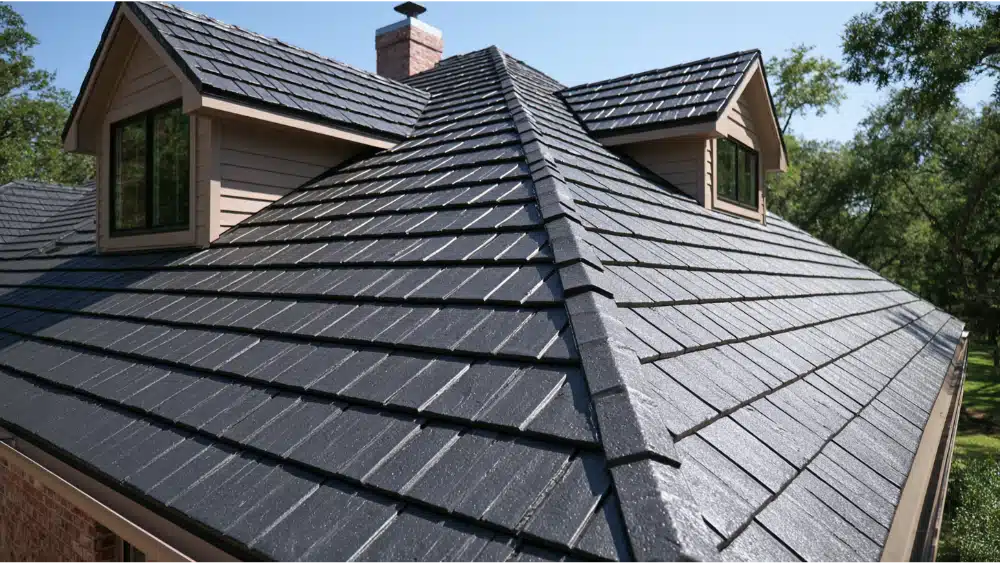
Panels begin as flat steel sheets, roll-formed into a profile that mimics traditional roofing materials, then coated with an acrylic base, embedded stone granules, and a clear overglaze. You’ll see “stone coated metal” and “stone coated steel” used interchangeably. Steel is the predominant substrate in U.S. roofing products, so either term usually points at the same thing.
What varies, and varies a lot, is the specification. Steel thickness, the corrosion-resistant coating, granule type, panel profile, and installation method all differ by manufacturer and product line. Two manufacturers can offer a shake profile that looks nearly identical on a sample board and still publish very different test results. Performance belongs to the tested assembly, not to the word “metal.”
Profile names are marketing names. On spec sheets you’ll run into barrel vault tile, pacific tile, villa tile, cottage shingle, and pine crest shake, and a similar shake look may be sold as Boral Steel or under another label. Major brands each use their own vocabulary, so compare evaluation reports rather than names.
How Stone Coated Steel Panels Are Built, Layer by Layer
The panel itself is built up in layers:
- Formed steel substrate
- Corrosion-resistant metallic coating
- Acrylic base layer
- Bonded stone granules
- Clear protective overglaze
The panel is only one part of the roof. Underneath sits the deck, usually solid plywood or OSB sheathing, then a synthetic underlayment. Interlocking panels are mechanically fastened either direct to deck or over battens that create an airspace. Flashing at valleys, walls, and penetrations handles water, and ventilation handles heat and moisture underneath.
When we say assembly, that’s what we mean. Fire ratings, wind ratings, and warranties attach to the whole system, not to the panel sitting on a pallet.
What Are the Benefits of Stone Coated Metal Roofing?
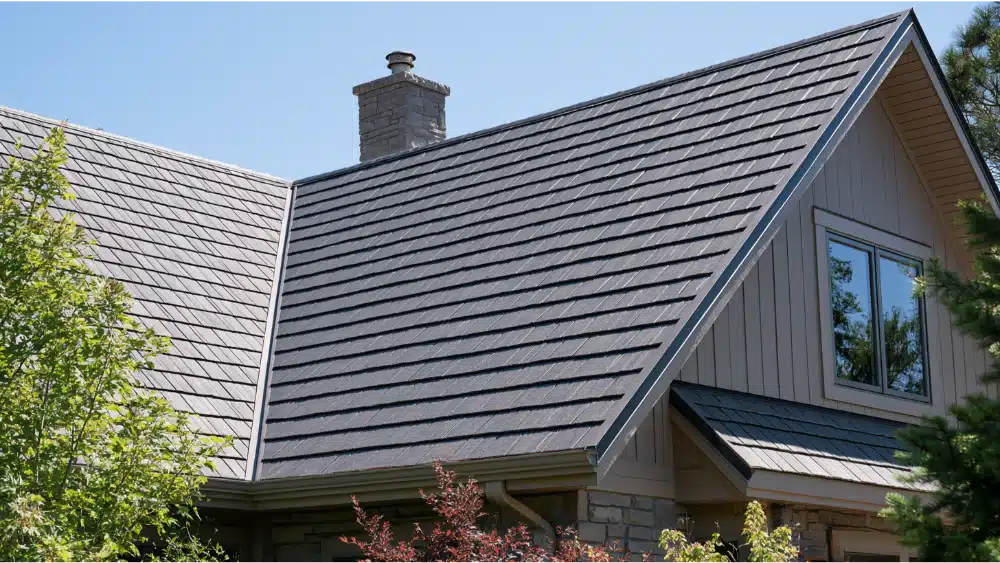
- Traditional curb appeal. Shake, slate, shingle, and tile profiles let you change what the roof is made of without changing the character of the street.
- Light weight for the look. One ICC-ES-evaluated system lists an installed weight of 1.3 pounds per square foot. That product-specific figure shows why these roofs get considered where masonry tile weight would overload existing framing.
- Resistant to cracking. Steel doesn’t shatter the way brittle concrete or clay tile can under impact or foot traffic.
- Documented durability. Fire, impact, and wind results exist in writing for many stone coated steel systems. Ask for them.
- Low maintenance. A properly installed metal roof asks for inspections and clear drainage, not constant attention.
- Cool-roof color options in some lines. Not every color qualifies, which we’ll get to.
What Are the Disadvantages of Stone Coated Metal Roofing?
This is the part most product pages skip, so here it is straight:
- Higher upfront costs than asphalt shingles, in both materials and labor.
- Fewer crews are trained on any specific panel system, and the details are unforgiving.
- Foot traffic in the wrong place can deform raised portions of the profile or crush side laps.
- Granules can be displaced over time or after impact, exposing bare metal in spots.
- Replacing a damaged panel is more involved than sliding in a new shingle.
- Profiles and colors get discontinued, so matching a repair ten years out can be difficult.
- Minimum slope requirements vary by profile, not just by category.
- A stone coated roof is not automatically a cool roof. Color and rating decide that.
How Does Stone Coated Steel Handle Extreme Weather Conditions?
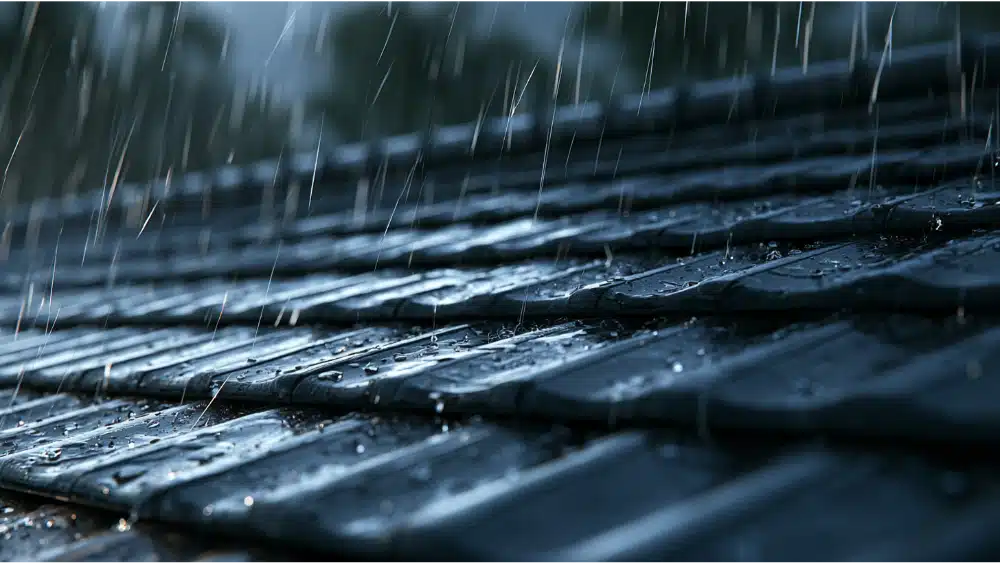
Fire
Roof fire classification comes from testing the complete assembly under ASTM E108 / UL 790, not from the fact that the exposed surface is fire resistant steel. Underlayment and deck construction both affect the result. Many systems can earn a Class A fire rating as part of a listed assembly installed exactly as tested, which is different from saying every stone coated roof is Class A.
Hail
UL 2218 is the impact-resistance standard behind Class 4 claims, and it measures penetration resistance. It is not a promise that hail won’t dent panels or knock granules loose. UL has noted that later IBHS testing protocols were developed partly to address damage modes, including denting and granule loss, that established impact tests don’t fully capture.
Wind
Wind performance depends on the product, the fastening schedule, concealed clips or exposed fasteners, deck condition, roof geometry, and site exposure. Test paths include ASTM D3161, UL 580, UL 1897, and FM 4474. Figures like 120 mph or 190 mph circulate online, but those wind ratings are tied to one approved configuration. Ask to see the evaluation report.
Heat and Energy
A steel substrate alone doesn’t make a metal roof cool. Solar reflectance, thermal emittance, and color decide that. The Cool Roof Rating Council rates both initial and aged properties, with standard aged ratings based on three years of outdoor weathering. Claims like “up to 25% off cooling costs” depend on the product, color, attic construction, and climate. Look up the exact product and color in the CRRC Rated Roof Products Directory.
Roof Pitch and Decking: Direct to Deck or Over Battens?
The 2024 IRC sets 3:12 as the minimum slope for metal roof shingles, and individual products can be stricter. One current ICC-ES report requires 4:12 for a shingle profile while allowing 3:12 for certain tile and shake profiles. Below the product’s minimum, the panels may only be used as decorative material over a separate code-compliant roof covering.
Decking drives the rest. Solid sheathing has to be sound and dry, and a tear off is often where rot or delamination shows up for the first time. Direct to deck installation fastens the panels through the underlayment into the sheathing. Battens raise the panels and open an airspace beneath them. Either way, the method has to match the assembly that was actually listed, because the two versions of the same product can carry different ratings.
Can Stone Coated Steel Be Installed Over Existing Asphalt Shingles?
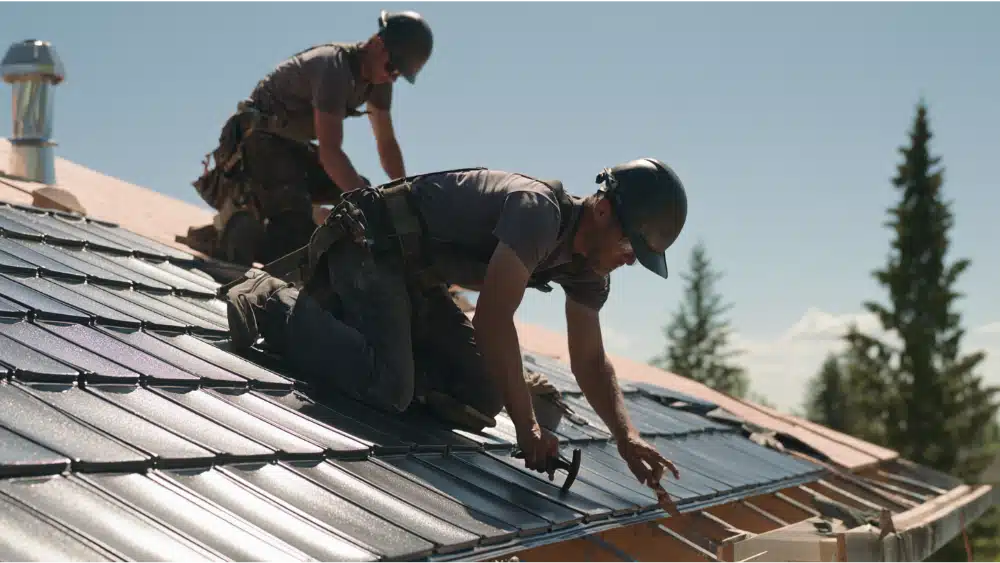
Sometimes, but not automatically. California’s current Existing Building Code generally calls for removal down to the deck during roof replacement, with limited exceptions. Recovering is not allowed when the existing roof is water-soaked, too deteriorated to support the new covering, or already carries two or more roof-covering applications.
A legitimate roof-over decision requires a deck inspection, confirmation that the product is approved for that application, building-department sign-off, a verified layer count, and proof that the fire classification still holds. Removal adds labor and disposal costs, which is one of the real drivers of project pricing and is worth discussing openly before you commit.
How Long Does a Stone Coated Metal Roof Last?
Decades, when the product suits the climate and the installation is right. The U.S. Department of Energy’s Building America Solution Center states that metal roofing can last up to 50 years or more, while emphasizing correct material selection, compatible metals, flashing, drainage, installation, and maintenance. That’s a general metal roof statement, not a stone coated category guarantee.
Long life comes down to coating quality, climate exposure, workmanship, drainage details, and how often someone walks on the roof. A written product warranty is a document with terms and exclusions. It is not the same as a durability promise, and it’s separate from your contractor’s workmanship terms. Read both.
Maintenance: Can You Walk on a Stone Coated Metal Roof?
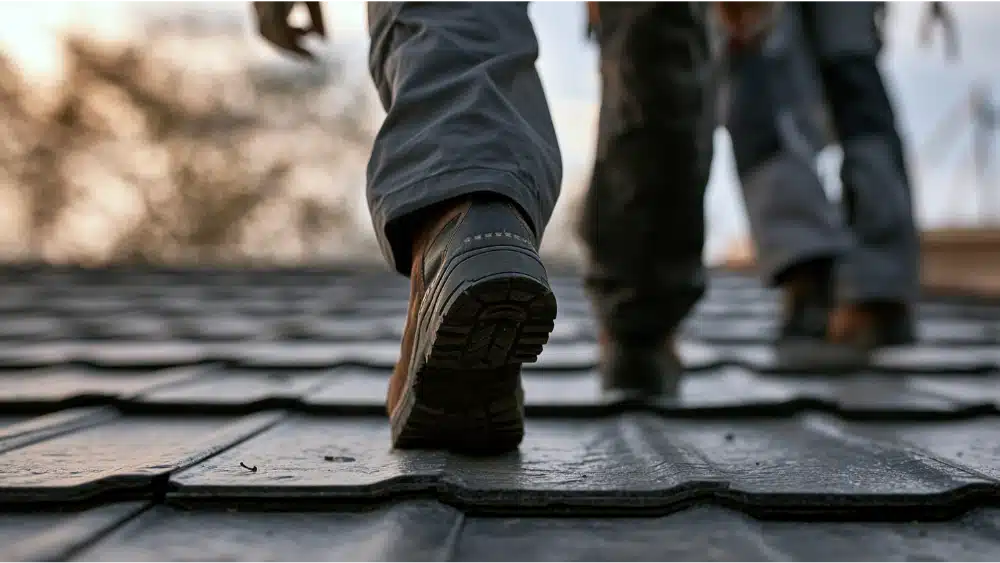
Yes, with care, and ideally only by someone who knows the specific profile. Installation guides typically direct foot traffic to the low portions of the tile and away from side laps. The practical takeaway for a homeowner: don’t treat your roof as a walking surface.
Minimal maintenance is not the same as no maintenance. Inspect annually and after major storms, keep valleys and gutters clear of debris, and watch for granule or coating damage, incompatible metals, or trapped debris that can start corrosion. Cosmetic granule loss and actual steel corrosion are different problems with different urgency, and a good inspection report tells you which one you have.
Stone Coated Metal vs. Asphalt Shingles, Concrete Tile, and Standing Seam
| System | Appearance | Relative weight | Repairability | Installer expertise needed |
|---|---|---|---|---|
| Stone coated steel | Traditional shake, slate, shingle, tile | Light | Moderate; panel-specific | High |
| Asphalt shingles | Conventional | Moderate | Easiest | Moderate |
| Concrete or clay tile | Traditional, dimensional | Heavy | Brittle; tiles crack | High |
| Standing seam steel | Contemporary, clean lines | Light | Panel-specific | High |
Standing seam reads contemporary. Stone coated steel reads traditional. That single difference settles the choice for a lot of homeowners before performance enters the conversation. Masonry tile delivers the look with real weight and real brittleness. Asphalt has the lowest material costs and the shortest life, typically replaced every 15 to 20 years. Other metal roofing materials, including aluminum, copper, and corrugated steel panels, serve different use cases entirely.
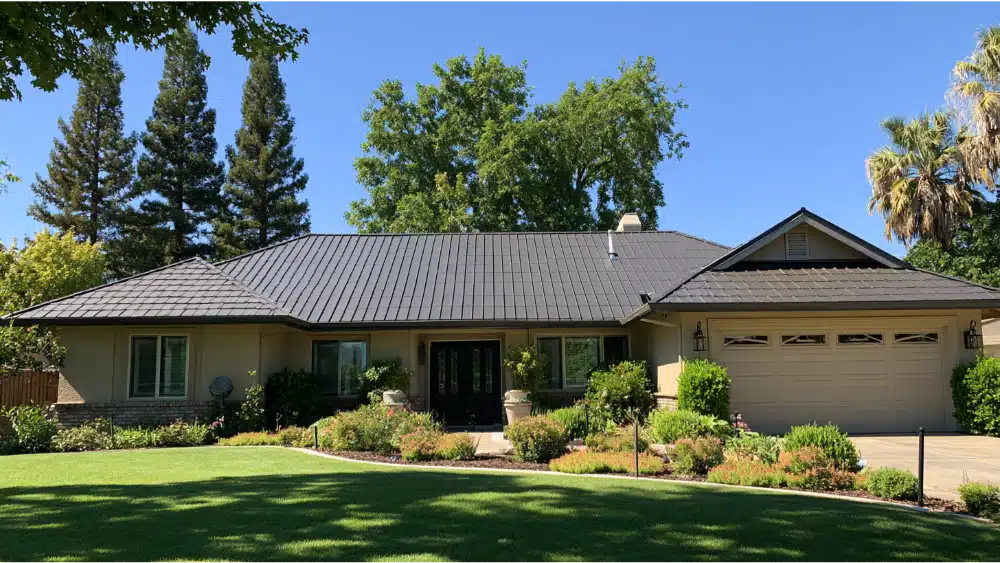
What Sacramento and Northern California Homeowners Should Check
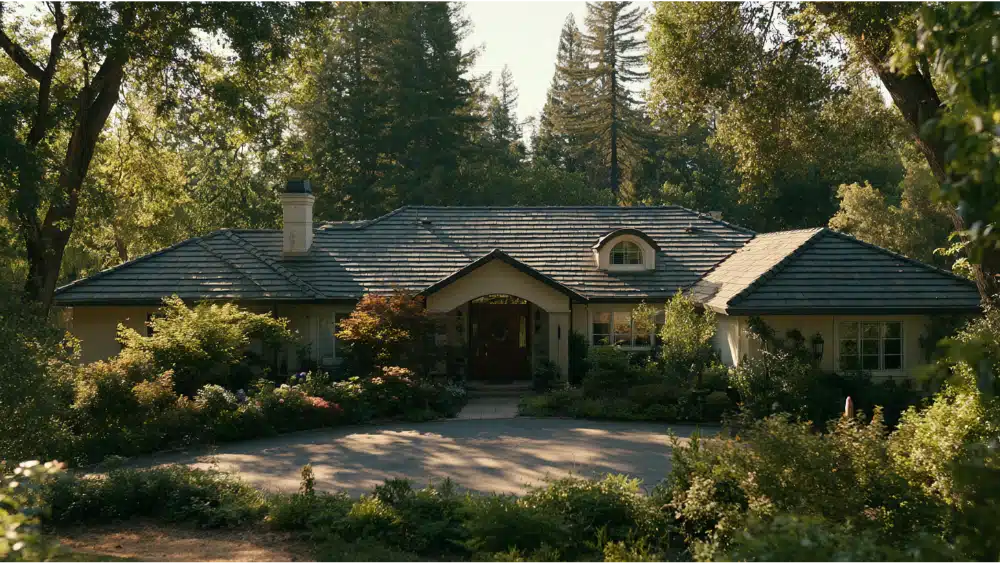
Re-roofing requires a permit in the City of Sacramento, handled as a minor permit for residential work. California’s 2025 Building Standards Code took effect January 1, 2026, so the edition your project falls under matters.
When more than 50% of a low-rise residential roof surface is replaced, the city applies cool-roof requirements. For steep slope, the prescriptive criteria are aged solar reflectance of at least 0.20, thermal emittance of at least 0.75, or an SRI of at least 16, using CRRC-tested and labeled products. Exceptions may apply for conditions such as R-38 ceiling insulation, a qualifying radiant barrier, no attic ducts, or R-2 insulation above the roof deck.
In wildfire-exposed areas, verify the complete tested assembly and check CAL FIRE’s Office of the State Fire Marshal Building Materials Listing. The California Department of Insurance recognizes Class A roofing as a qualifying action under Safer from Wildfires, though any premium effect depends on your insurer. Plan for valley heat, dust, attic ventilation, and future solar or rooftop HVAC penetrations while the roof is still on paper.
Questions to Ask Before You Choose
- What is the exact product, manufacturer, and profile being proposed, and its minimum approved slope?
- Is there a current ICC-ES or comparable evaluation report?
- What complete assembly earned the stated fire classification?
- Which wind and impact standards were used, and at what configuration?
- Is this exact color CRRC-listed?
- Is the roof going direct to deck or over battens, and does that match the listing?
- Is removal required, or is a roof-over approved and permitted?
- How will valleys, penetrations, and future solar or HVAC work be handled?
- What do the written product and workmanship documents actually cover?
Is Stone Coated Steel Roofing Right for Your Home?
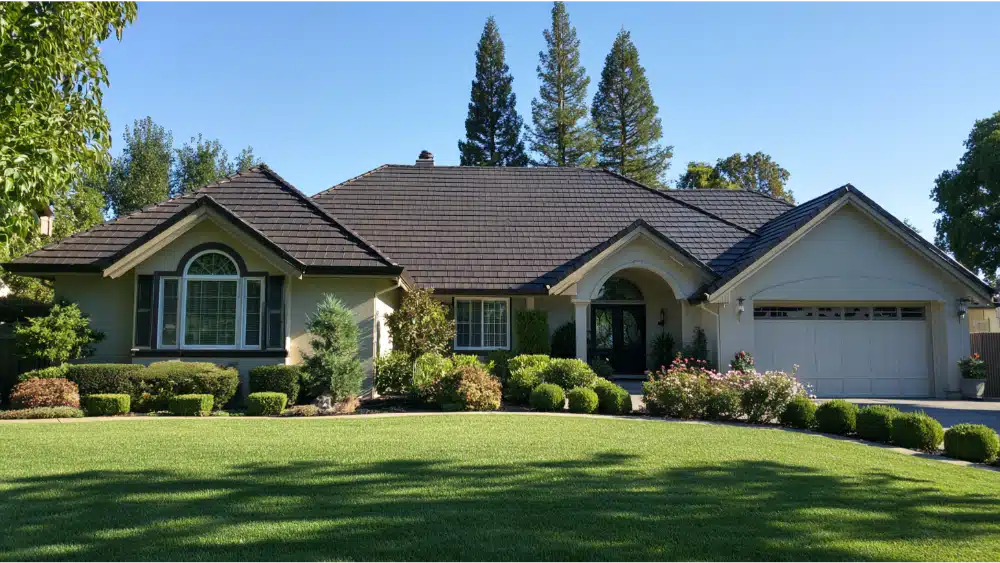
It’s a strong fit when: a traditional tile, shake, or shingle appearance matters to you; you plan to stay long term; your pitch meets the profile’s minimum; documented fire and weather performance is a priority; and a qualified installer with a fully documented system is available.
Consider another system when: your pitch falls below the product minimum; replacement panels would be hard to source later; no experienced installer works in your area; you want a smooth, contemporary look; or the documentation is incomplete.
The right roof gets decided by inspecting the home, not by a category claim on a brochure.
Talk Through Your Roof With Our Team
We’re family-owned and operated, we run in-house crews, and we chose to specialize in exteriors because depth beats breadth on work like this. CSLB License #1031864, BBB accredited since 2017. If you’d like a free, no-obligation inspection and estimate, it starts as a quick conversation about your roof, not an application. Call 916-745-6699. We serve Sacramento, Roseville, Elk Grove, Fair Oaks, Fresno, and Redding.
Stone Coated Metal Roofing FAQs
What is the price of stone coated metal roof tiles?
Pricing depends on roof size and complexity, profile and color, removal and deck repairs, flashings and penetrations, slope, and access. Anyone quoting a figure without seeing the roof is guessing. We’d rather look first and give you a free, no-obligation on-site estimate.
What is the best material for roof decking?
Solid sheathing in good condition, typically plywood or OSB, installed per the panel system’s instructions. Both work. What matters is that the deck is sound, dry, and approved for that product, which is why a deck inspection should come before any quote.
What is the 25% rule for roofing?
It’s a rule of thumb that when repairs affect roughly a quarter or more of a roof surface, replacing the covering usually makes more sense than patching. The governing requirement is always your local building department and the applicable code edition.
How long does stone coated steel roofing last?
Decades. The Department of Energy cites metal roofing generally as lasting 50 years or more under suitable conditions. Whether your roof proves that durable depends on the product, climate, installation quality, and maintenance, and the written warranty governs what’s covered.